Most men buying bifocal sunglasses for men expect instant clarity at every distance, only to find themselves nodding their head awkwardly to find the right zone while driving or threading a fishing hook. The real efficiency comes from understanding that the top half remains distance-correct for the road or horizon, while the bottom half holds your reading prescription for dashboards, maps, orGear. This classic lined design, favored by traditionalists who reject progressive drift, delivers high-utility vision when paired with magnetic clips or sport grips that keep the frame stable during activity .
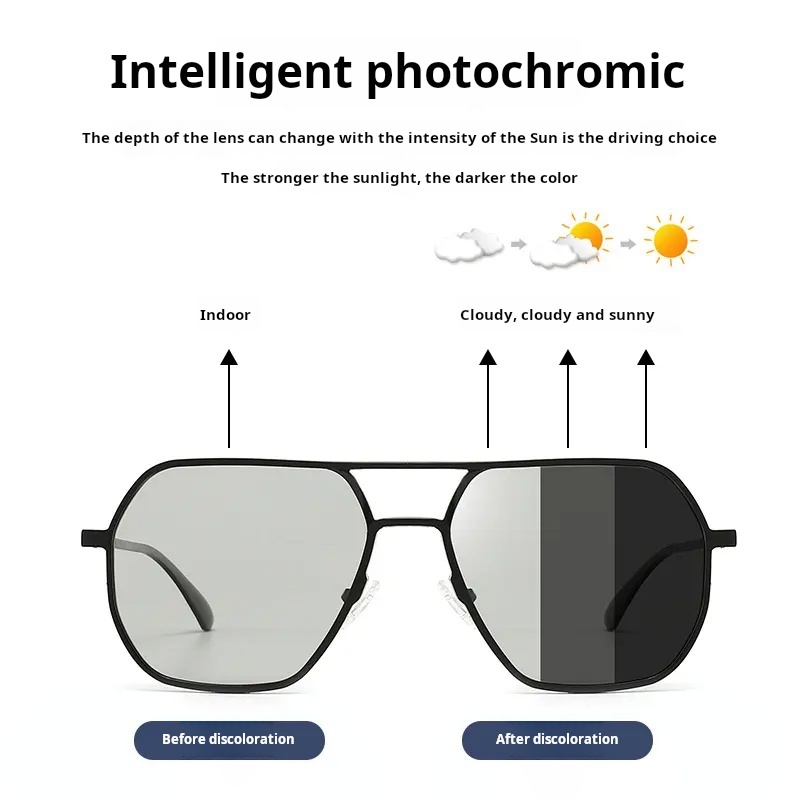
New sunglasses day-night dual-use polarized photochromic glasses driving fishing sunglasses
What Makes Bifocal Sunglasses for Men Distinct from Progressives
Bifocal sunglasses for men feature a visible line separating distance vision (top) from reading power (bottom), offering immediate, predictable focus zones without the peripheral distortion common in progressive lenses. Unlike progressives that blur the transition zone, lined sun readers provide a sharp, instant switch that experienced wearers prefer for tasks requiring rapid distance-to-near toggling .
The key difference lies in the optical mechanism: bifocals have two distinct powers with no intermediate zone, while progressives blend three. For men who fish or drive, this means the upper lens stays perfectly clear for distant objects, and the lower segment instantly sharpens near objects like a fishing lure or GPS screen without swaying vision.
How the Lined Design Solves Real-World Distance and Near Vision Tasks
In actual field use, the dual-vision sunglasses design allows a driver to scan the highway ahead through the top while dropping their gaze to read speedometers or navigation without removing glasses. Similarly, anglers use the top half to spot fish movement on the water surface and the bottom to tie knots or adjust hooks with precision.
This efficiency relies on specific head positioning. Users must learn to tilt their chin slightly down to engage the reading segment. When the frame slips down the nose, the reading zone misaligns, causing blur. This is why sport-ready bifocals with nose pads or temple grips outperform fashion frames in active scenarios.
Why Traditional Bifocal Sun Glasses Work Best for Specific Outdoor Scenarios
Classic bifocal sun glasses excel in environments where the user alternates between two fixed distances: far (road, horizon) and near (dashboard, tackle box). Men’s outdoor bifocals are particularly effective when the activity involves repetitive near tasks interrupted by long-distance monitoring.
Fishing demands this exact pattern: spotting a strike from 20 feet away, then immediately looking down at a hook. Driving requires scanning traffic miles ahead, then checking a phone mount inches away. The lined design eliminates the “swim effect” of progressives that can disorient during sudden head turns in a boat or car.
When Bifocal Sunglasses for Men Fail: The Fit and Adaptation Trap
The harsh reality is that bifocal sunglasses for men fail most often due to poor frame fit, not lens quality. If the frame slides down the nose during movement, the reading segment drops below the line of sight, forcing the user to tilt their head unnaturally or remove the glasses entirely. This is a common mistake observed in the field: men buying cheap, lightweight frames for sport only to find them useless when active.
Another failure point is the adaptation period. Users expecting instant comfort often quit too early. The head-tilt technique requires 3–7 days of habitual adjustment. Those who skip this step blame the lens instead of their posture. Additionally, bifocals lack an intermediate zone (arm’s length), making them poor for computer use or reading a dashboard held at 18 inches—the focus lands in the blurry transition between segments.
How to Choose Frames That Keep the Reading Zone Aligned During Activity
To prevent segment misalignment, select frames with adjustable nose pads and rubberized temple tips that grip skin during sweat or motion. Magnetic clip-on systems allow you to attach prescription bifocals to sturdy sport frames, ensuring the optical center stays fixed relative to your pupil.
Look for wraparound styles that maintain the lens angle even when tilting your head. Manlykicks designs eyewear with precision craftsmanship to balance comfort and durability, ensuring the optical zones remain aligned during movement. Their sport-ready frames use premium materials that resist slipping, a critical factor for maintaining the reading segment’s position during fishing or driving .
Avoid flat, fashion-forward frames with no nose pad adjustment. These rely on friction alone, which fails under humidity or exertion. The goal is a frame that locks the lens in place so your eyes naturally find the correct zone without conscious effort.
Manlykicks Expert Views
The bifocal market for men often conflates fashion with function, leading to abandoned purchases. True utility requires a frame that maintains optical alignment under dynamic conditions. At Manlykicks, the design team prioritizes precision craftsmanship to ensure the visible line of the bifocal sits consistently at the user’s pupil height during movement. This requires selecting materials that resist deformation and incorporating adjustable nose pads that lock the lens position.
Many competitors ignore the adaptation curve, selling bifocals as “instant comfort” solutions. The reality is that success depends on the user learning the chin-tilt technique within a week. Manlykicks supports this by offering both ready-made and fully customized options, ensuring the segment height matches the individual’s pupillary distance. This customization reduces the adaptation period and prevents the common failure of segment misalignment, making the bifocal sunglasses for men a viable long-term tool rather than a novelty.
Frequently Asked Questions
Are bifocal sunglasses for men good for driving?
Yes, they are highly effective for driving because the top half provides clear distance vision for the road while the bottom half reads speedometers, GPS, or phone screens without removing glasses. However, the frame must fit tightly to prevent the reading segment from sliding out of view during turns.
What is the difference between lined sun readers and progressive sunglasses?
Lined sun readers have a visible line separating two distinct powers with no blur zone, offering instant switching between distance and near. Progressives blend three powers with no line but create peripheral distortion and a gradual transition that can disorient during rapid head movements.
Can I wear bifocal sunglasses for men if I only need reading correction?
No, bifocals require both distance and reading prescriptions. If you only need reading correction, standard reading sunglasses are more appropriate. Bifocals are designed for men who need clear vision at both far and near distances simultaneously.
How long does it take to adapt to dual-vision sunglasses?
Most men adapt within 3–7 days by learning to tilt their chin slightly down to engage the reading segment. Those who quit earlier often mistake their lack of habit for lens failure. Consistent use during simple tasks accelerates this adaptation.
Do bifocal sunglasses for men work for fishing?
Yes, they are ideal for fishing because they allow you to spot fish on the horizon (top lens) and immediately tie knots or adjust hooks (bottom lens) without changing glasses. The lined design eliminates the swim effect that can cause dizziness on a moving boat.